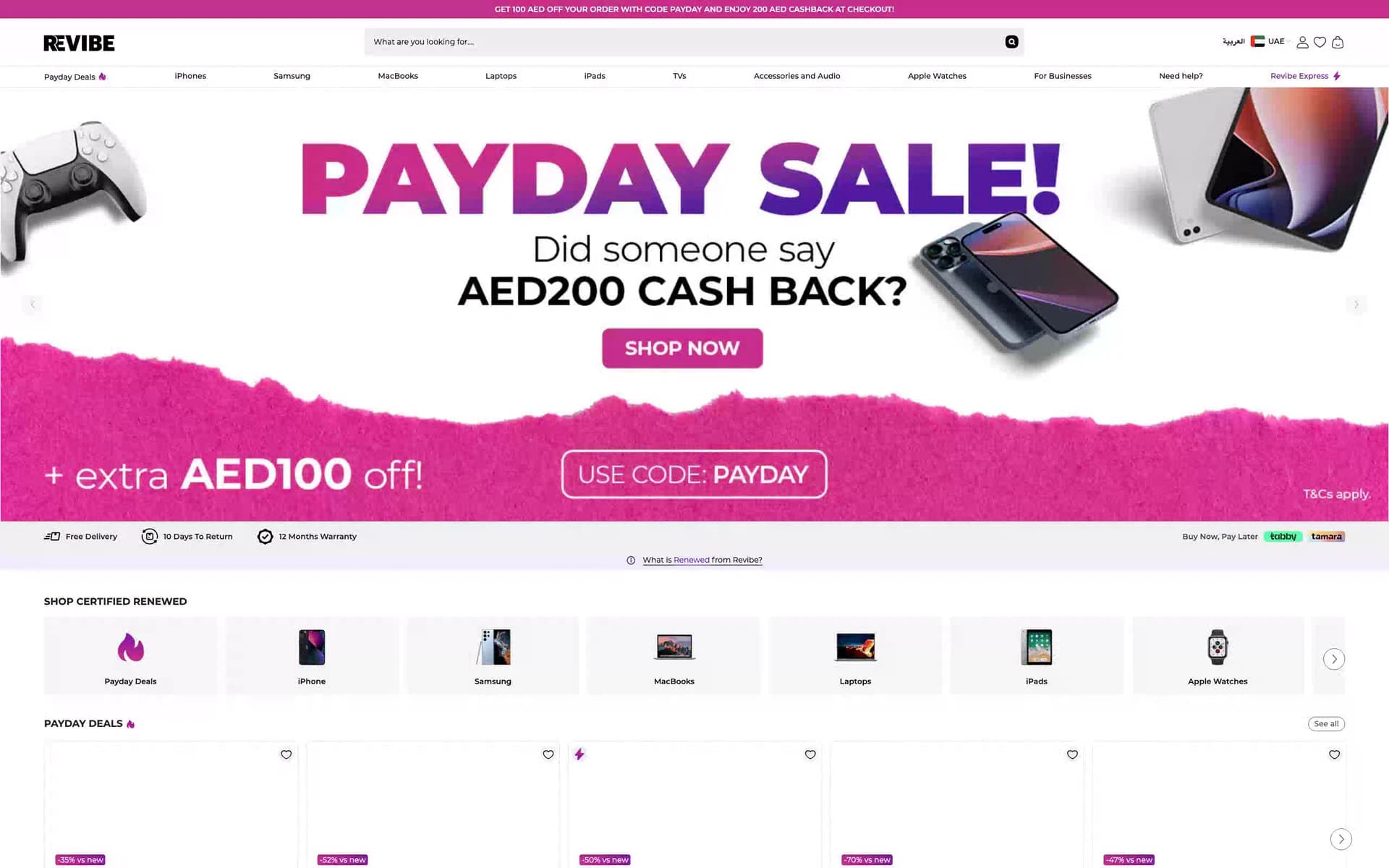
A refurbished-electronics store that earned the buyer's trust.
Used iPhones at Apple-Store prices won't move themselves. We rebuilt the storefront around grade transparency, warranty surfacing, and one-tap mobile checkout.

- Client
- Revibe
- Sector
- E-commerce · Refurbished Electronics
- Engagement
- Discovery → Build → Launch
- Year
- 2025
✱ § 01 · The brief
What they actually needed.
Revibe sells refurbished iPhones, MacBooks, AirPods, and Galaxy phones in the UAE. The catalog was right, the pricing was right, the warranty programme was best-in-class. But the storefront read like a generic Shopify clone, and 78% of cart sessions were on mobile.
Customers landed on the homepage, browsed three product pages, then bounced. Trust didn't carry past the listing. The grade scale was buried in a tooltip. The warranty terms lived three clicks deep. The cart was a separate page, not a drawer. On mobile especially, the experience punished the fastest path to purchase.
“We don't have an inventory problem. We have a 'do customers trust us with a £600 used phone' problem.”
✱ § 02 · Our approach
Three bets, in order.
Surface grade and warranty on every product card.
Grade (A / A+ / B+) shown next to price, with a one-line plain-language explainer on the card. Warranty length and return window inline below. No tooltips, no FAQs. The trust signals live where the buyer is looking.
Collapse cart to a drawer, checkout to one screen.
Mobile-first slide-in cart with grade and warranty repeated. Single-step checkout: Apple Pay first, card second, Tabby third. Address autofill via Google Places. Guest by default.
Build the blog as a buying guide, not a brochure.
Editorial guides ranking iPhone generations, comparing grades, and explaining battery health, written for SEO and shopper anxiety. Internal links from product pages to the relevant guide.
✱ § 03 · Process · 12 weeks
From kickoff to shipped.
Wk 1–2
Discovery + audit
Session replays on 320 abandoned carts, 95% mobile. Five customer interviews, three with returning buyers. Shopify + Stripe data pull on the previous 90 days.
Wk 3–4
Information architecture
Re-modeled the catalog around device family + grade + storage. Designed the trust strip pattern that runs on every product card.
Wk 5–8
Build · phase one
Custom Shopify theme, drawer cart, single-step checkout, mobile-first product pages. First end-to-end purchase end of week 8.
Wk 9–10
Soft launch + measure
10% of mobile traffic for two weeks. Fixed two Apple Pay edge cases and a Tabby threshold. Iterated copy on the warranty strip.
Wk 11–12
Full launch + content
Cut 100% of traffic to the new site. Shipped the first six SEO buying guides. Old store kept hot for 30 days as a fallback.
✱ § 04 · Gallery · key screens
Selected screens.
✱ § 05 · Results · measured 6 months post-launch
What changed, in numbers.
- +186%
- Conversion rate
- −68%
- Cart abandonment
- 1.2s
- Mobile LCP
Pre-launch baseline 1.4% → 4.0%
82% → 26% on mobile
Down from 4.6s on iPhone 12 / 4G
✱ § 07 · In their words
ChampX rebuilt the storefront around the buyer's anxiety, not our spec sheet. Mobile cart abandonment was halved in the first month.
Founder
Revibe · Revibe
✱ § 08 · Tech stack
What's running.
- Storefront
- Shopify · Custom theme
- Lifecycle
- Klaviyo (email + SMS)
- Payments
- Apple Pay · Card · Tabby
- Search + filters
- Shopify Search & Discovery
- Analytics
- GA4 · Hotjar · Shopify Analytics
- Hosting
- Shopify · Cloudflare
✱ § 09 · Team
Who built it.
- Affan Manzoor
- Project lead
- ChampX design
- Design + storefront
- ChampX engineering
- Theme + checkout
- ChampX content
- SEO blog launch
✱ § 10 · Honesty section
What we’d do differently.
01 · Wrote the guides too late
SEO content shipped in week 11. Should have been week 4. Google takes weeks to index, and the conversion lift compounded slowly over the launch window.
02 · Underestimated Tabby's threshold UX
Customers on £400+ orders expected Tabby visible from the product page, not just the cart. Added a 'pay in 4' badge to product cards two weeks post-launch.
03 · Mobile cart drawer needed a slow reveal
The instant-show drawer felt aggressive. Added a 200ms slide-in with a quiet haptic on iOS. Bounce inside the cart dropped further.